Manual Hashtags vs Generators: What Drives Reach?

Creators Grid Team
August 13, 2026
You spent twenty minutes hunting down thirty hashtags, meticulously checking post counts and pasting them into your caption. You hit publish, expecting a fresh wave of non-follower impressions — only to watch your Reel flatline at 350 views.

The truth is that neither purely manual tag hunting nor blindly copying automated tag blocks will fix low reach on modern social platforms. An effective hashtag research strategy works by treating hashtags as semantic context signals for recommendation algorithms, not magic visibility switches. Automated generators excel at surfacing related long-tail keywords in seconds, while manual research validates whether those tags match actual viewer search intent. Creators who combine algorithmic generators for rapid keyword discovery with manual curation for topic relevance routinely outperform those who rely on either approach alone.
Over the past two years, recommendation engines on Instagram, TikTok, and YouTube have undergone a massive structural shift. Computer vision models inspect your visual frames, natural language processing (NLP) parses your transcript, and automated audio analysis scans your spoken words before a single user sees your upload. In this environment, hashtags no longer force the algorithm to show your content to random users. Instead, they act as explicit metadata anchors that help recommendation engines confirm what your content is about.
If you are already struggling with converting Reel views into followers, stacking unvetted tags only creates mixed signals for distribution systems. According to Sprout Social's hashtag guidance, platforms now prioritize semantic contextual accuracy over raw tag volume, making your tag selection method a make-or-break decision for discoverability.
Copying and pasting the exact same block of 30 hashtags across every post triggers automated spam filters on Instagram and TikTok, suppressing discovery. Always rotate at least 40% of your tags per upload.
How Recommendation Algorithms Read Hashtags Today
To understand why the debate between manual selection and automated generators exists, you first need to understand how platform algorithms digest metadata. Social media architectures operate on vectors — mathematical representations of topic clusters. When you upload a video about camera gear, the recommendation engine creates an initial concept cluster based on your video transcript, visual elements, and caption text.
Hashtags serve as high-density classification labels that reinforce that concept cluster. When your tags match your visual and spoken content, the algorithm gains high confidence in categorizing your post. High confidence translates into faster distribution to a test group of interested viewers.
Conversely, when your hashtags are vague, hyper-saturated, or mismatched, algorithmic confidence drops. A post about home coffee brewing tagged with broad labels like #lifestyle or #trending gets queued behind posts with tight, specific tagging signals. Building a sustainable hashtag research strategy requires understanding how metadata interacts with content indexing rather than chasing viral shortcuts.
This fundamental mechanism explains why both purely manual tag building and unedited automated outputs frequently fail when used in isolation.
The Case for Manual Hashtag Research
Manual hashtag selection is the traditional approach favored by social media strategists who prioritize precision over speed. This method involves opening search bars directly on Instagram or TikTok, typing primary seed keywords, and evaluating the resulting top posts, post counts, and related search suggestions by hand.
The primary strength of manual research is deep contextual awareness. When you manually inspect a hashtag search result page, you see human context that software often misses. You can instantly detect if a hashtag has been co-opted by spam, shadowbanned by platform moderators, or dominated by a completely different niche than yours. For instance, #apple might seem like a straightforward tag for a tech reviewer, but manual inspection quickly reveals a mix of tech unboxings, fruit recipes, and local orchard promotions.
As highlighted in Metricool's Instagram SEO study, manual audits remain essential for identifying niche tags where your account can reliably achieve top-grid placement. By identifying tags with low competition but high active engagement, smaller accounts can secure sustained top-posts placement that generates ongoing non-follower reach.
However, manual research carries severe operational drawbacks:
- Time Inefficiency: Spending 15 to 30 minutes per post auditing tag volumes destroys publishing velocity.
- Cognitive Bias: Creators tend to repeatedly rely on familiar tags they remember rather than discovering emerging niche terms.
- Narrow Volume Horizon: Humans rarely brainstorm beyond two or three levels of semantic association without assistance.
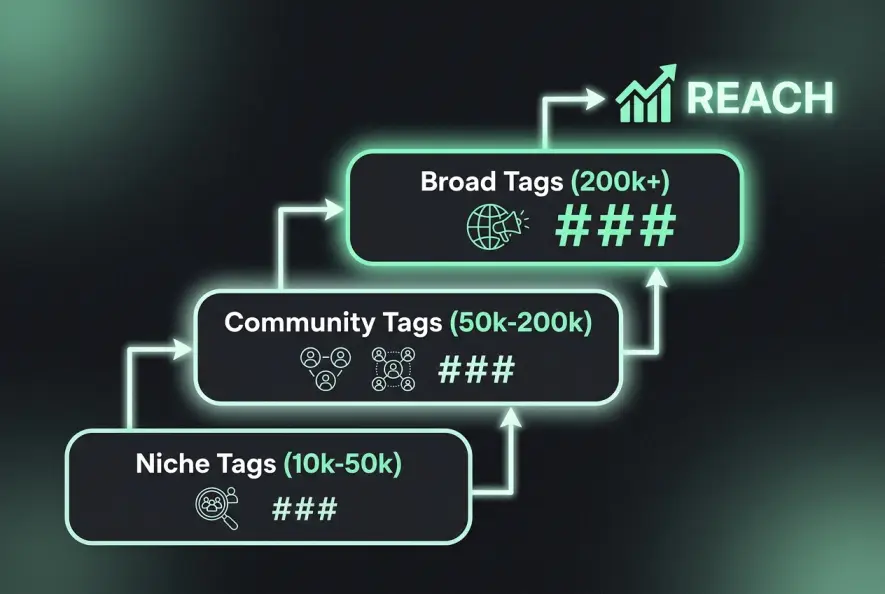
Pair hyper-specific niche tags (10k-50k posts) with mid-tier community tags (100k-500k posts) to secure initial ranking momentum before targeting high-competition broad tags.
When Hashtag Generators Outperform Manual Hunting
Automated hashtag generators approach discoverability from a data-processing perspective. Instead of relying on manual search bar queries, generators analyze seed terms against vast database indices to output dozens of related, contextual tags instantly.
The undeniable advantage of automated tools is velocity and semantic expansion. An automated tool can take a core topic like "portrait photography" and immediately return hyper-specific long-tail variants like #portraitlighting, #naturalflightportraits, and #50mmportraiture — keywords that might take an hour of manual digging to compile.
When you need to expand a core topic into semantic variations quickly, using a fast browser utility like Creators Grid's Instagram Hashtag Generator gives you a targeted seed list to filter down, cutting ten minutes of manual typing into ten seconds.
When evaluated as a speed multiplier, automated tools are a core component of a modern hashtag research strategy for busy content teams managing multiple accounts across YouTube Shorts, Instagram Reels, and TikTok.
| Feature | Manual Research | Hashtag Generators |
|---|---|---|
| Time per Post | 15–30 minutes | 10–30 seconds |
| Contextual Accuracy | Extremely high | Moderate to high (requires vetting) |
| Keyword Expansion | Limited by memory | Massive semantic variation |
| Spam/Ban Identification | Immediate visual detection | Requires periodic manual checks |
| Scalability | Hard to scale across multi-account workflows | Effortless multi-platform scaling |
However, relying 100% on automated generators without human editing creates distinct risks. Generators cannot feel the cultural nuance of a community. If a tool generates an over-saturated tag with 50 million posts, your content will be buried within three seconds of publishing.
The 4-Step Hybrid Hashtag Framework
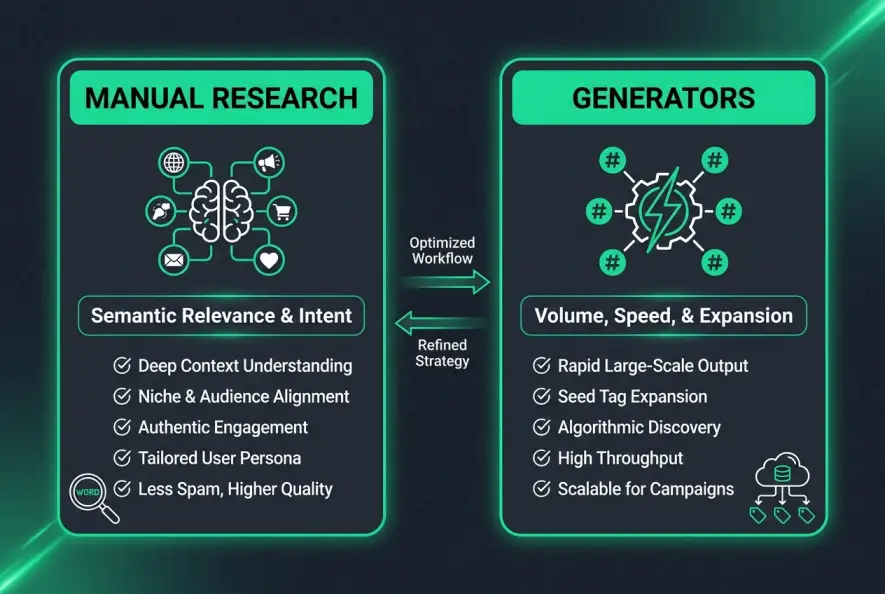
The highest-performing creators do not pick sides in the manual vs. generator debate. Instead, they run a hybrid system that uses automated software for fast keyword generation and human judgment for final curation.
Step 1: Automated Seed Expansion
Begin by inputting your post's main topic into a reliable generator. If your Reel covers editing short-form video, enter "video editing tips." Allow the tool to generate 20 to 30 related keyword variations spanning broad, mid-tier, and niche categories.
Step 2: Semantic Intent Curation
Copy the raw output into your workspace and run a quick 60-second visual audit. Delete any tag that does not explicitly match what happens in your video. Official documentation from Meta's official creator guidance stresses that keeping metadata strictly aligned with actual video content prevents distribution penalties.
Step 3: Implement the Hashtag Ladder
Organize your curated tags using a structured ladder ratio to maximize distribution probability:
- 2 Broad Tags (500k+ posts): Contextual anchors for major topic categorization.
- 4 Mid-Tier Community Tags (100k–500k posts): Balanced competition for steady reach.
- 3 Hyper-Niche Tags (10k–100k posts): High-probability top-grid placement targets.
By implementing this hybrid workflow, your hashtag research strategy transforms from a chaotic guessing game into a predictable system for expanding organic reach.
This workflow seamlessly complements a structured system for repurposing video content, ensuring every snippet reaches its intended target audience without spending hours on repetitive administrative tasks.
Final Verdict: Which Strategy Moves the Needle?
If forced to choose exclusively between pure manual research and raw generator outputs, manual research wins on accuracy while generators win on speed. But running an account on extreme ends of either spectrum creates unnecessary friction.
Automated tools give you the semantic building blocks in seconds, while your creator intuition provides the quality control. Ultimately, the most effective hashtag research strategy isn't an either-or choice — it's using software to handle keyword discovery and human judgment to handle relevance.
Creators Grid Team
Empowering creators.
Actionable insights, strategies, and tools for the next generation of digital creators.
Frequently Asked Questions
Current platform data indicates that quality and context beat quantity. Utilizing 5 to 8 hyper-relevant hashtags organized across different volume tiers typically outperforms dumping 30 generic tags into your caption.
Yes, but TikTok uses tags primarily for search indexing and topic categorization rather than direct FYP pushing. 3 to 5 targeted hashtags matching your spoken transcript help TikTok categorize your video faster.
Using a platform-flagged or spam-heavy hashtag won't permanently ban your account, but it can temporarily hide that specific post from search results and topic feeds. Periodically spot-check your recurring tags manually.
Placing hashtags directly in the caption is superior for search engine indexing. Modern NLP algorithms parse captions immediately upon upload, whereas comment-section tags can experience indexing delays.
You should rotate at least 40% of your tags on every upload. Reusing static copy-paste blocks across dozens of uploads flags your profile as automated activity in platform moderation systems.
Generators uncover far more long-tail and semantic variants than human memory can recall, but human intuition is required to filter out tags that lack cultural context or topic alignment.